A Learner-Centred View of Assessment in the Early Years
With insights from NEP 2020, NCF, and Bloom’s 2 Sigma Problem
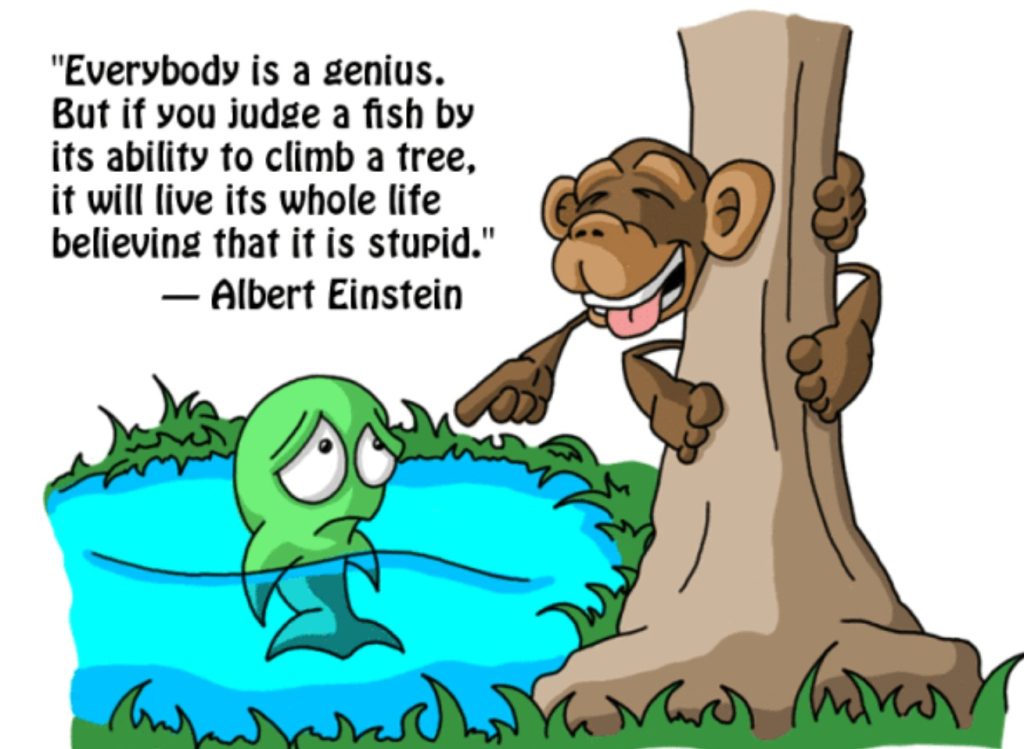
The Tree-Climbing Test: A Familiar Problem
Imagine a classroom where a monkey, a fish, a bird, and an elephant are all asked to do the same task: climb a tree.
The monkey succeeds.
The bird struggles.
The fish fails completely.
The conclusion drawn?
Some are “smart.” Others are “weak.”
This is exactly what happens when every learner is assessed in the same way, at the same time, using the same tool.
The failure here is not of the learner.
It is a failure of the system.
Why Uniform Assessments Are Not the Same as Fair Assessments
When all learners are given identical assessments, some are bound to fail—not because they lack ability or effort, but because the assessment ignores how differently children learn.
In the foundational and preparatory stages, this is especially damaging.
Early failure:
- Does not motivate
- Does not build discipline
- Does not improve learning
Instead, it quietly erodes confidence, curiosity, and self-belief.
For a young child, marks are not separate from identity. Repeated failure quickly becomes:
“I am not good at learning.”
Once curiosity is lost, learning becomes mechanical—and sometimes stops altogether.
There Are No Bad Learners—Only Missed Instructional Opportunities
A powerful shift occurs when we change the question.
Instead of asking:
❌ “Why didn’t the child learn?”
We ask:
✅ “What do I need to change in my teaching so the child can learn?”
Just as a doctor never says, “This patient cannot be treated differently,” a teacher cannot say, “This child cannot be taught differently.”
When learning does not occur, it does not mean:
- The learner is weak
- The learner is incapable
It means:
- A learning gap has not yet been identified
- The teaching approach has not yet aligned with the learner
- The assessment is not capturing the learner’s understanding
This belief lies at the heart of NEP 2020, which clearly states that learning outcomes depend on quality of teaching and appropriate pedagogy, not on labelling learners.
Assessment as a Mirror for Teachers
In the early years, assessment should not function as a judgement of children.
It should function as feedback for teaching.
This is the essence of Assessment for Learning.
Effective assessment helps teachers reflect:
- Did my explanation make sense?
- Did I use the right examples?
- Does this child need more time, a different representation, or hands-on experience?
Seen this way, assessment becomes a tool for improvement, not a tool for sorting learners.
Why Early High-Stakes Assessment Causes Harm
Both NEP 2020 and the National Curriculum Framework (NCF) strongly caution against:
- High-stakes testing
- Rote-based assessments
- Ranking and comparison in early years
When uniform, high-pressure assessments dominate:
- Fear replaces exploration
- Curiosity declines
- Confidence erodes
For many learners—especially first-generation learners—assessment becomes an experience of public judgement, not private growth. Labels are internalised early and begin shaping identity.
This is why NEP and NCF emphasise joyful, meaningful, and developmentally appropriate learning, supported by continuous and formative assessment.
The Case for Personalised and Differentiated Assessment
Children learn and express understanding in different ways:
- Some speak confidently
- Some draw or visualise
- Some build, move, or demonstrate
- Some need more time or repetition
A fair assessment system does not force all learners to show learning in one way.
Instead, it offers multiple pathways.
Personalised and differentiated assessment may include:
- Oral explanations and conversations
- Drawings, diagrams, and visual representations
- Models, manipulatives, and hands-on tasks
- Teacher observations and reflective discussions
This aligns strongly with the NCF’s constructivist and experiential philosophy, where learning is actively built—not passively memorised.
Judging all learners through a single mode of assessment is not equality.
It is exclusion.
Bloom’s 2 Sigma Problem: What Research Reveals
Educational researcher Benjamin Bloom posed a critical question known as the 2 Sigma Problem.
His research showed that:
- Learners taught through one-to-one tutoring performed two standard deviations (2 sigma) better than those taught through traditional whole-class instruction
- The average learner receiving personalised support outperformed 98% of learners in conventional classrooms
The implication is profound.
When teaching is personalised and responsive:
- Most learners can achieve high levels of understanding
- “Failure” dramatically reduces
NEP 2020 builds on this insight by emphasising:
- Early identification of learning gaps
- Targeted interventions
- Small-group and individualised support
The conclusion is clear:
The problem is not the learner. The gap lies in identification and instructional response.
Assessment must therefore guide teaching decisions, not ranking systems.
Assessment as Learning: Empowering the Learner
Assessment is not only for teachers—it is also for learners.
When children are encouraged to reflect:
- What did I understand today?
- What was difficult?
- What can I try differently next time?
they begin to take ownership of learning. This is known as Assessment as Learning.
It nurtures:
- Metacognition (thinking about one’s thinking)
- Confidence
- A growth mindset
Mistakes stop being failures and start becoming feedback.
Assessment of Learning: Documenting Growth, Not Defining Ability
In the early years, assessment of learning should be:
- Descriptive
- Holistic
- Developmental
Portfolios, anecdotal records, and narrative feedback provide a fuller picture of growth across:
- Cognitive
- Social
- Emotional
- Physical
- Language domains
A single score can never capture a learner’s potential.
A Moral Responsibility—Not Just a Pedagogical Choice
Early schooling shapes a child’s lifelong relationship with education.
A young learner does not separate marks from self-worth.
If assessment:
- Diminishes dignity
- Creates fear
- Labels ability
it contradicts the spirit of NEP 2020 and NCF.
Assessment must protect:
- Confidence
- Curiosity
- Joy in learning
So, What Are We Really Assessing?
When everyone is given the same assessment, we are not ensuring fairness—we are exposing systemic rigidity.
In the foundational and preparatory years, assessment must act as:
- A mirror for teachers
- A support for learners
- A guide for better teaching
Because educational reform does not begin with exams.
It begins with empathy, reflection, and responsive teaching.
And most importantly, it begins with the belief that:
There are no bad learners—only systems that must learn to teach better.